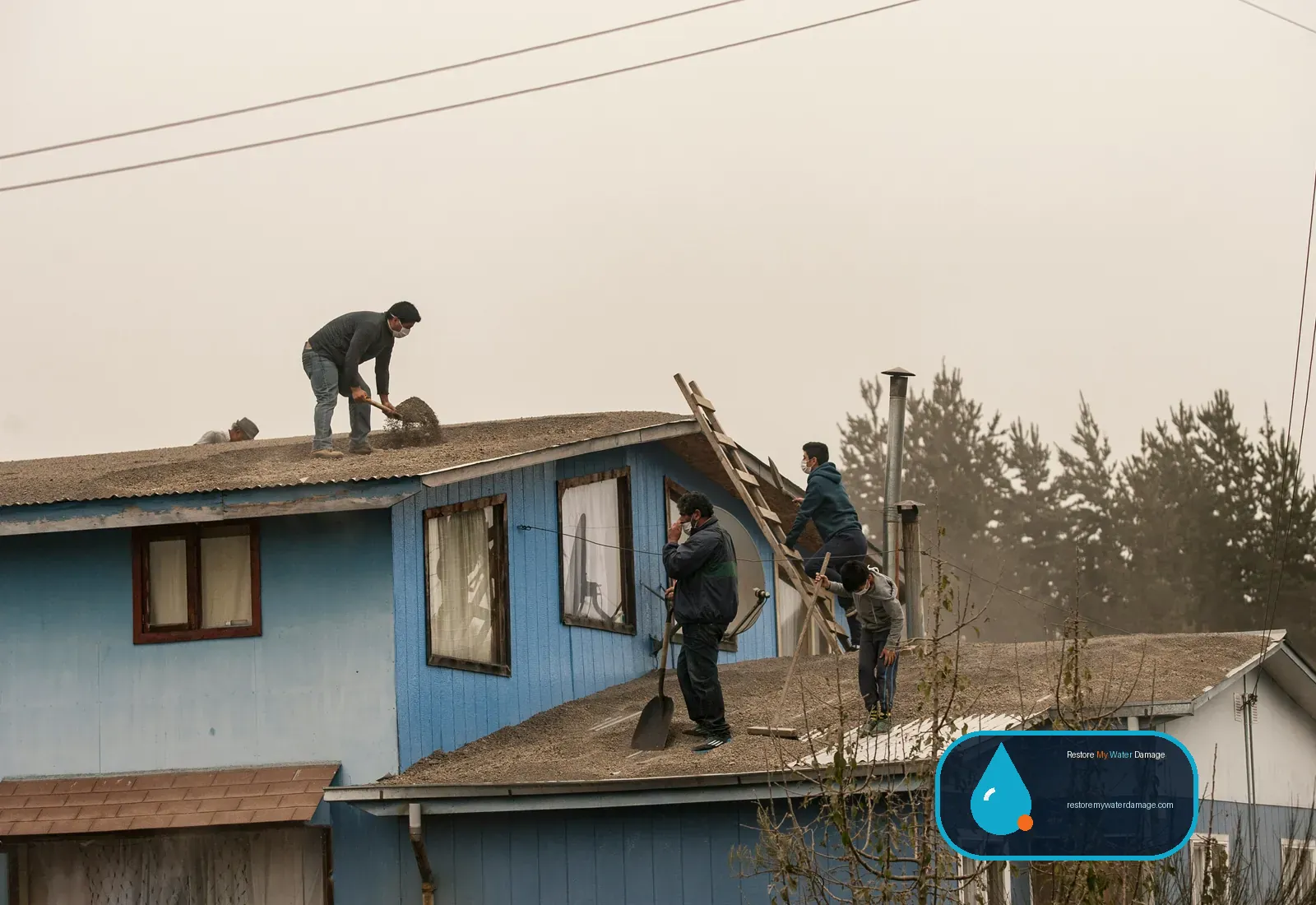
Storms test every part of a building's envelope at once. High winds lift shingles, driving rain finds gaps in window flashing, clogged gutters overflow into fascia and walls, and falling limbs punch holes through roofs. When rain gets inside, the damage is often hidden: saturated attic insulation, wet wall cavities, and ceilings that look fine until they sag. This guide explains how storm and rain water damage happens, how professionals restore it, what you can safely do right away, and how insurance usually treats these losses.
What counts as storm and rain water damage?
Storm and rain water damage is any water intrusion into a building caused by weather: rain entering through a wind-damaged roof, wind-driven rain forced through windows and siding, overflow from blocked gutters and downspouts, hail-damaged skylights, and tree impacts. It is different from flood damage, which is surface water rising from outside and entering at ground level, though a single storm can cause both.
That distinction matters for both restoration and insurance. Rain entering from above often begins as relatively clean water, while floodwater is treated as Category 3 contaminated water. If rising water entered your home or business, see our page on flood damage restoration for the stricter process that applies.
Common entry points during storms
- Roof coverings: missing, lifted, or cracked shingles, torn membrane on flat roofs, and displaced tiles or metal panels
- Flashing: failed or loosened flashing around chimneys, skylights, vents, and wall-to-roof transitions
- Roof vents: ridge vents, turbine vents, and soffit vents that admit wind-driven rain
- Windows and doors: worn seals, failed caulk, missing sill pans, and damaged glazing
- Siding and trim: gaps, damaged housewrap, and open penetrations for pipes or wires
- Gutters and downspouts: clogs that push water behind fascia or dump it against foundations
- Tree and debris impacts: punctures through roofs, walls, and windows
- Ice dams: in winter storms, meltwater backing up under shingles

What should you do first after rain gets inside?
Put safety first, then limit further water entry, then document. Check for electrical hazards and structural damage, catch active drips with buckets, move belongings away from wet areas, photograph everything, and contact your insurer. Arrange professional tarping or board-up to stop more rain, and call a restorer to begin extraction and drying before moisture spreads deeper into the structure.
Storm water damage first-response checklist
- Check for hazards. Look for downed lines outside, sparking, burning smells, or water near electrical fixtures. If in doubt, stay out and call the utility or emergency services.
- Shut off power to affected areas at the breaker, but only if the panel is dry and you are not standing in water.
- Keep people clear of sagging ceilings. A bulging ceiling can hold a surprising amount of water.
- Catch active leaks with buckets, bins, and towels. Place plastic sheeting over furniture and electronics.
- Move valuables and contents out of wet rooms, starting with electronics, documents, photos, and rugs.
- Photograph and video the exterior damage from the ground, interior ceilings, walls, floors, and damaged items.
- Notify your insurer and ask what documentation and temporary repairs they expect.
- Arrange temporary protection. Professional tarping, board-up of broken windows, or plastic sheeting over openings.
- Start professional drying. Call (833) 435-4276 — we answer 24 hours a day, 7 days a week.
- Keep receipts for anything you buy or pay for, including tarps, hotels, and equipment.
Our general guide on what to do after a water leak covers additional steps that apply to any water event.
What not to do
- Do not climb onto a wet or damaged roof, especially during wind or at night.
- Do not use household vacuums to remove water; they are not built for it and pose shock risks.
- Do not turn on ceiling fans or lights in wet ceilings.
- Do not throw away damaged items before they are documented, unless they present a health hazard.
- Do not paint over water stains or close up walls before materials are verified dry.
What is emergency tarping and why does it matter?
Emergency tarping is the temporary covering of a damaged roof with heavy-duty tarps secured by wooden battens or other fastening methods to keep rain out until permanent repairs are made. It matters because drying cannot succeed while water is still entering, and many insurance policies expect property owners to take reasonable steps to prevent further damage after a loss.
How professional tarping is typically done
- Assess roof safety from the ground and, when safe, from the roof with fall protection.
- Photograph the damage before covering it, which helps the insurance adjuster.
- Remove loose debris, such as branches, from the damaged area when possible.
- Size the tarp to extend well beyond the damage, often up and over the ridge so water sheds over it rather than under it.
- Secure the tarp with wood battens fastened through the tarp edges, minimizing new penetrations.
- Check for wind-lift points and add battens as needed.
- Re-inspect after additional storms, since tarps are temporary and can loosen or degrade under UV exposure.
Sandbags alone, or tarps held only by ropes, are more likely to fail in wind. Board-up applies the same logic to broken windows and doors, using plywood to secure openings against rain, wind, and intruders.
Tarping is a temporary measure. Roofs should be permanently repaired by a qualified roofing contractor, and some jurisdictions require permits for roof replacement. Ask your insurer how they want temporary and permanent repairs documented.
Where does rain water damage hide?
Rain water rarely stays where it lands. It soaks attic insulation, runs along rafters and top plates, wicks down inside wall cavities, pools on top of ceiling drywall, and travels under flooring. By the time a stain appears on the ceiling, insulation and framing above may already be saturated. Professionals use moisture meters and thermal imaging to find these wet areas without unnecessary demolition.
Attics and roof decking
Blown-in or batt insulation acts like a sponge. Once soaked, it compresses, loses insulating value, and holds moisture against drywall and framing. Wet fiberglass batts sometimes can be dried if the water was clean and exposure was brief, but saturated or contaminated insulation is commonly removed. Roof sheathing, particularly OSB, can swell and delaminate when wet for extended periods.
Ceilings
Drywall ceilings lose strength when saturated. Staining, sagging, cracking tape joints, and nail pops are warning signs. Textured ceilings in older homes may contain asbestos and should be tested before they are disturbed.
Walls
Wind-driven rain entering around windows often wets the framing and insulation inside the wall below the window, with little visible sign on the interior. Peeling paint, bubbling, baseboard swelling, and soft drywall are common indicators. Exterior walls may also have wet sheathing that dries very slowly.
Floors
Water running down walls ends up at the floor, soaking carpet pad, the edges of hardwood, and subfloors. Hardwood may cup as moisture enters from below, and laminate often swells at seams.

How does storm water damage restoration work?
Professional storm water damage restoration follows a sequence: secure the building envelope, assess water category and class, extract standing water, remove materials that cannot be salvaged, set up dehumidifiers and air movers to dry the structure, monitor moisture daily until drying goals are met, and then repair roofing, drywall, insulation, and flooring. Each step follows IICRC S500 principles adapted to the specific building.
1. Secure the envelope
Tarping, board-up, and temporary sealing come first. Drying equipment cannot keep up with ongoing rain intrusion.
2. Inspect and map moisture
Technicians trace water from each entry point, using penetrating and non-penetrating moisture meters, thermo-hygrometers, and thermal cameras. They take reference readings from unaffected materials to set drying goals.
3. Determine category and class
Category describes contamination; class describes how much water was absorbed and how difficult drying will be. Rain through a roof opening may be Category 1 or 2, while water that picked up attic debris or sat for days can degrade. Class is often higher in storm losses because ceilings and walls, not just floors, are wet. Learn more in our guide to water damage categories and classes.
4. Extract water
Standing water is removed from floors with extractors. Carpet may be extracted and dried in place when water is clean and the pad can be managed, or removed if contaminated or badly saturated. See water extraction and structural drying for how extraction and drying work together.
5. Controlled demolition
Saturated ceiling drywall, wet insulation, and carpet pad are removed when drying in place is not practical or safe. Flood cuts, where drywall is removed a set height above the wet line, allow wall cavities to dry.
6. Drying and dehumidification
Air movers increase evaporation from wet surfaces while dehumidifiers remove the moisture from the air. For ceilings and walls, specialized cavity drying systems may push dry air into enclosed spaces. Attics may require separate drying setups.
7. Monitoring
Technicians record temperature, relative humidity, and material moisture daily, adjusting equipment as materials dry. This documentation also supports insurance claims.
8. Cleaning and treatment
Affected surfaces are cleaned, and antimicrobial products may be applied where appropriate. Odor control may be needed if water sat for some time.
9. Repairs and reconstruction
After verification of dryness, permanent roof repair, insulation replacement, drywall, texture, paint, and flooring can proceed. Our page on water damage repair and restoration explains that phase in detail.
Which materials can be saved after rain damage?
Salvageability depends on the water category, how long materials stayed wet, and the material itself. Framing lumber and many hardwood floors can often be dried. Drywall may be dried in place if exposure was short and the water clean. Saturated insulation, ceiling tiles, carpet pad, and particleboard furniture are frequently replaced. Anything contaminated by floodwater usually requires removal.
| Material | Often salvageable when | Often replaced when |
|---|---|---|
| Wood framing | Structurally sound and dried to target moisture | Rotted, heavily damaged, or significantly mold-affected |
| Ceiling drywall | Briefly wet with clean water, no sagging | Sagging, crumbling, or contaminated |
| Wall drywall | Wet briefly with clean water and dries well | Saturated for days, delaminated, or visibly moldy |
| Fiberglass batt insulation | Lightly wet with clean water, can be dried | Saturated, compressed, or contaminated |
| Blown-in cellulose | Rarely | Usually when significantly wet |
| Carpet | Clean water, extracted quickly | Delaminated, contaminated, or wet too long |
| Carpet pad | Rarely | Usually replaced when saturated |
| Solid hardwood floors | Dried promptly with specialty systems | Severe cupping, buckling, or long exposure |
| Laminate and engineered wood | Minor edge exposure | Swollen seams or wet core |
| Roof sheathing (OSB/plywood) | Short exposure, no swelling | Delaminated, soft, or rotted |
These are general tendencies, not rules. A qualified professional makes material-by-material decisions based on readings and condition.

How is wind-driven rain different from a roof leak?
A roof leak usually has a visible entry point, such as a missing shingle or damaged flashing, and water follows a relatively traceable path downward. Wind-driven rain is forced horizontally or upward into walls through siding laps, window frames, and vents, often wetting entire wall sections with no obvious opening. It tends to affect multiple walls on the windward side of a building.
Signs of wind-driven rain intrusion
- Moisture or staining below windows on the side of the house facing the storm
- Wet carpet along exterior walls with no ceiling stain above
- Water around ridge or soffit vents in the attic
- Swollen window sills or trim
- Peeling paint or bubbling on exterior walls days after the storm
Because the water is inside wall cavities, restoration may require removing baseboards, drilling small holes for cavity drying, or opening sections of drywall. Exterior repairs, such as resealing windows and replacing damaged flashing, prevent recurrence.
How does insurance handle storm and rain water damage?
Many homeowners and commercial property policies cover interior water damage when a covered peril, such as wind or hail, first creates an opening that lets rain in. Policies often exclude flood, gradual leaks, and damage from poor maintenance, and some treat rain entering through existing gaps differently. Deductibles for wind or hurricane damage may be a percentage of the dwelling coverage. Always check your specific policy.
Coverage concepts to understand
- Opening created by a covered peril: Many policies require that wind, hail, or a falling object first created the opening through which rain entered.
- Flood exclusion: Standard homeowners policies typically exclude rising surface water; separate flood coverage may apply.
- Wear and tear: Deteriorated roofs, failed caulking, and long-standing leaks are frequently excluded.
- Named storm or wind deductibles: In some coastal areas, special deductibles apply and may be much larger than a standard deductible.
- Mitigation duty: Policies generally expect you to take reasonable steps to prevent further damage.
- Mold limitations: Some policies cap or exclude mold remediation.
Documentation that helps a storm claim
- Exterior photos of the roof, siding, windows, and fallen trees, taken safely from the ground
- Interior photos of every affected room, including ceilings
- Date and time of the storm; local weather reports can support timing
- Receipts for tarps, board-up, and emergency services
- Moisture readings and drying logs from your restorer
- An inventory of damaged contents with approximate values
See our guide to water damage insurance claims and the overview of water damage and homeowners insurance for more.
How much does storm water damage restoration cost?
Storm water damage costs vary widely. A small ceiling leak dried quickly may cost a few hundred to a couple thousand dollars for mitigation, while widespread damage involving attics, multiple rooms, and wall cavities can reach many thousands before roof and interior repairs. These are rough general national estimates; actual costs depend on the extent of damage, materials, region, and contamination.
| Cost factor | Why it affects the price |
|---|---|
| Emergency tarping or board-up | Size and pitch of roof, access, and safety equipment |
| Affected square footage | More area requires more labor and equipment |
| Ceilings and attic involvement | Overhead demolition, insulation removal, and attic drying |
| Wall cavity drying | Specialty equipment and additional monitoring |
| Water category | Contaminated or floodwater requires more removal and cleaning |
| Delay before mitigation | Longer wet times increase removal and mold risk |
| Reconstruction | Roofing, drywall, paint, insulation, and flooring are separate costs |
For more on estimating, visit our water damage restoration cost guide.
What is the mold risk after rain damage?
Mold risk rises the longer materials stay wet. In warm, humid post-storm conditions, microbial growth can start within roughly 24 to 48 hours on drywall paper, insulation, and wood. Attics and wall cavities are especially prone because they are dark and poorly ventilated. Prompt drying and verification with moisture meters are the best prevention.
If you notice musty odors, spotting on ceilings or walls, or discoloration on attic sheathing in the days or weeks after a storm, have the area assessed. Mold remediation follows the IICRC S520 standard and typically involves containment, HEPA filtration, removal of affected porous materials, and cleaning. Learn more on our page about mold and water damage.
How can you reduce storm water damage in the future?
Most storm water intrusion can be reduced with routine exterior maintenance: keeping gutters and downspouts clear, inspecting roofs and flashing, sealing windows and penetrations, trimming trees, and preparing before storm season. None of these guarantee protection from severe weather, but they lower the odds that ordinary storms turn into interior water damage.
Storm-season maintenance checklist
- Clean gutters and downspouts, and extend downspouts several feet from the foundation.
- Have the roof inspected for lifted, cracked, or missing shingles and failing flashing.
- Check attic ventilation and look for past water staining on sheathing.
- Reseal gaps around windows, doors, and exterior penetrations.
- Trim dead limbs and branches overhanging the roof.
- Confirm the grade slopes away from the foundation.
- Test sump pumps and consider battery backup where basements are prone to water.
- Keep a tarp, plastic sheeting, buckets, and a flashlight accessible.
- Photograph your property's current condition for insurance reference.
- Review your policy's wind, flood, and water damage provisions before storm season.
Our full water damage prevention guide expands on these steps. If you have a basement, see basement water damage restoration for storm-related seepage and sump failures.
What about storm damage to commercial buildings?
Commercial buildings face the same forces, but flat and low-slope roofs, rooftop HVAC units, large window systems, and parapet walls create additional vulnerabilities. Ponding water on flat roofs can find small membrane breaches and travel far before appearing inside. Restoration often requires coordination with roofing contractors, building engineers, tenants, and multiple insurers, along with phased work to keep operations running where safe.
Property managers should keep an emergency contact list, know where roof access and utility shutoffs are, and pre-plan which areas are most critical to protect. For details, see our commercial water damage restoration page. When storms hit, call (833) 435-4276 — we answer 24 hours a day, 7 days a week with Restore My Water Damage.
Why do flat roofs and skylights leak during storms?
Flat and low-slope roofs drain slowly, so heavy rain can pond and exploit small membrane seams, punctures, or clogged drains. Skylights rely on flashing and seals that age and crack, and hail can fracture older acrylic domes. Because water on flat roofs can travel under the membrane before dripping through, the interior leak is often far from the actual breach, which makes professional leak tracing important.
Common flat roof failure points
- Clogged roof drains, scuppers, and gutters that cause ponding
- Open seams in membrane roofing such as TPO, EPDM, or modified bitumen
- Failed flashing at parapet walls and rooftop equipment curbs
- Punctures from foot traffic, dropped tools, or debris
- Deteriorated pitch pans around penetrations
Skylight leak indicators
- Staining on drywall around the skylight well
- Condensation dripping in cold weather, which can mimic a leak
- Cracked glazing or displaced seals after hail
- Rust on metal frames or flashing
How do ice dams cause water damage?
Ice dams form when heat escaping from the living space melts snow on the upper roof, and the meltwater refreezes at the colder eaves. Water then pools behind the ridge of ice and backs up under shingles, leaking into attics, exterior walls, and ceilings along the edges of the home. Damage often shows up as stains along exterior walls near the ceiling or wet insulation at the eaves.
Reducing ice dam risk
- Improve attic insulation to keep heat in the living space.
- Air-seal attic bypasses, such as around light fixtures, chimneys, and attic hatches.
- Ensure balanced attic ventilation from soffits to ridge.
- Keep gutters clear before winter.
- Use a roof rake from the ground to remove snow from the lower roof edge after heavy snowfall.
- Ask a roofer about ice and water shield membranes when replacing a roof.
How should belongings be handled after rain damage?
Move wet belongings to a dry, ventilated space as soon as it is safe, photograph them before cleaning or discarding, and separate items by material. Hard, non-porous items can usually be cleaned and dried. Upholstered furniture, mattresses, and books wet with clean rainwater may be salvageable if dried quickly, but items soaked by floodwater or left wet for days often need to be discarded.
| Item type | First step | Notes |
|---|---|---|
| Electronics | Unplug and do not power on | Have them evaluated before use |
| Documents and photos | Separate, air dry, or freeze in sealed bags | Freezing can buy time for professional drying |
| Upholstered furniture | Elevate and dry with air movement | Replace if contaminated or musty |
| Area rugs | Remove from wet floors | Professional cleaning may be needed |
| Clothing and linens | Launder promptly | Prevent mildew by washing within a day or two |
| Wood furniture | Wipe and dry slowly away from direct heat | Rapid heat can crack or warp wood |
Keep an itemized list with photos, descriptions, approximate age, and value to support your insurance claim. Our water damage restoration checklist can help you stay organized. For general cleanup steps, see water damage cleanup.
How do you avoid storm-chasing contractors?
After major storms, unfamiliar contractors often go door to door offering quick repairs. Some are legitimate, but others take deposits and disappear or do poor work. Protect yourself by verifying business registration and any required licenses, confirming insurance, getting written estimates, avoiding large upfront payments, and reading every document before signing, especially anything that assigns your insurance benefits.
- Be cautious of contractors who arrive uninvited and pressure you to sign immediately.
- Verify the company's address and registration with your state.
- Ask for proof of liability insurance.
- Never pay the full amount before work is completed.
- Be wary of offers to waive or absorb your deductible.
- Check with your insurer before agreeing to a scope of work.
Our guide to choosing a water damage restoration company offers a full vetting checklist.
Can overflowing gutters cause interior water damage?
Yes. Clogged or undersized gutters overflow during heavy rain, sending water behind fascia boards, down exterior walls, and against the foundation. That water can rot fascia and soffits, seep through window and door openings, and saturate soil next to basement walls until it enters through cracks or the joint between wall and floor. Short downspouts that discharge next to the house make the problem worse.
- Behind the gutter: water runs under the drip edge and rots roof decking at the eaves.
- Exterior walls: sheets of overflow soak siding and find gaps around windows.
- Foundations: saturated soil increases pressure on basement walls, leading to seepage.
- Landscaping: soil and mulch piled against siding can channel water into wall bottoms.
Regular cleaning, properly sized gutters, downspout extensions, and grading that slopes away from the home all help. If water has already reached a lower level, our basement water damage restoration page explains the drying process for below-grade spaces.
Frequently Asked Questions
Is storm water damage covered by homeowners insurance?
Many homeowners policies cover sudden water damage when a storm first creates an opening, such as wind tearing off shingles or a tree puncturing the roof, and rain then enters. Rising surface water flooding is typically excluded and requires separate flood insurance. Damage from long-term roof deterioration is often excluded as a maintenance issue. Policy language varies, so review your policy and speak with your agent or adjuster.
How quickly should rain water damage be dried?
As soon as possible. Wet drywall, insulation, and wood can begin supporting microbial growth within roughly 24 to 48 hours in warm conditions. Starting extraction and controlled dehumidification quickly limits how far moisture wicks into walls and subfloors and reduces how much material needs to be removed. Temporary roof protection should go up first so drying is not undone by the next rain.
What is wind-driven rain?
Wind-driven rain is rain pushed sideways or upward by strong winds, forcing water through gaps that normally shed water, such as window frames, siding laps, soffit and ridge vents, and door thresholds. It can wet wall cavities with no visible opening in the building. Some insurance policies treat wind-driven rain differently from rain that enters through storm-created openings, so check your policy language.
Is rain water considered clean water?
Rain falling directly through a roof opening often starts as Category 1 or Category 2 water, but it can pick up contaminants from roofing materials, insulation, bird droppings, and debris. If it sits, it can degrade further. Water that rises from outside ground level, such as flooding, is considered Category 3 because it carries soil, sewage, and chemicals. A professional assesses category on site.
Should I remove wet ceiling drywall myself?
Be careful. A sagging, water-filled ceiling can collapse suddenly and cause injury. Keep people out from underneath, move belongings, and if the bulge is small, some professionals puncture it to drain into a bucket, but only if you can do so safely away from light fixtures and wiring. Turn off power to that area first. Generally, let a professional evaluate before removing ceiling materials.
Can I tarp my own roof after a storm?
Climbing a wet, damaged roof is dangerous, especially in wind or darkness, and falls cause serious injuries. If you can safely reduce leaks from inside with buckets and plastic, do that and wait for a professional. Many insurance policies expect reasonable steps to prevent further damage, and professional tarping is typically considered part of that. Keep receipts and photos of any temporary repairs.
How long does storm damage restoration take?
Drying typically takes several days for many losses, but storm projects often take longer overall because roof repairs, contractor availability after regional storms, and insurance inspections add time. Heavily saturated walls, hardwood floors, and plaster can extend drying. Reconstruction can take weeks. Your timeline depends on the extent of damage, materials, and how quickly the building is sealed from further rain.
Do I need a mold inspection after a roof leak?
Not always. If the leak was caught quickly and materials were professionally dried and verified with moisture readings, mold may never develop. Consider an assessment if the leak went unnoticed for days, you see staining or growth, notice a persistent musty odor, or anyone in the home has health sensitivities. Attic insulation and sheathing are common places for hidden growth after roof leaks.
How much does storm water damage repair cost?
Storm water damage repair costs vary widely. Nationally, drying out a rain-soaked room often runs roughly $1,000 to $4,000, while extensive roof leak damage with ceiling, insulation and drywall replacement can reach $5,000 to $15,000 or more. Roof repairs are usually priced separately. Independent providers set pricing based on the affected area and materials. Call (833) 435-4276 24/7 and we'll connect you with local help.
What should I do right after rain water comes into my house?
Put buckets under drips, and if a ceiling is sagging, stay out from under it and keep power off to that area. Move belongings away, extract standing water, and photograph everything. Cover roof or window openings temporarily if it is safe to do so from the ground. Start drying within 24 to 48 hours to limit mold. Call (833) 435-4276 24/7 and we'll connect you with local help.
Does flood insurance cover storm surge and rising water?
Standard homeowners insurance usually excludes flooding from rising surface water, storm surge and overflowing rivers. That damage is typically covered only by a separate flood insurance policy, such as through the National Flood Insurance Program or a private flood insurer. Rain entering through a storm-damaged roof or window is more often covered under homeowners policies.
Can storm water damage hardwood floors be saved?
Sometimes. If rainwater is clean and drying starts quickly, hardwood can often be dried with specialized floor drying mats and dehumidifiers, though some cupping may remain. Boards soaked by outside floodwater, or those buckling, separating from the subfloor or showing mold, usually need replacement. A moisture meter reading compared to unaffected wood tells you whether drying is working. Call (833) 435-4276 24/7 and we'll connect you with local help.
How can I tell if storm water got inside my walls?
Look for bubbling paint, stains, swelling baseboards, a soft spot when you press drywall, or a musty smell a few days after the storm. Water often travels down framing from roof or window leaks without showing on the surface. Restoration technicians use moisture meters and thermal cameras to find wet wall cavities before hidden mold develops.