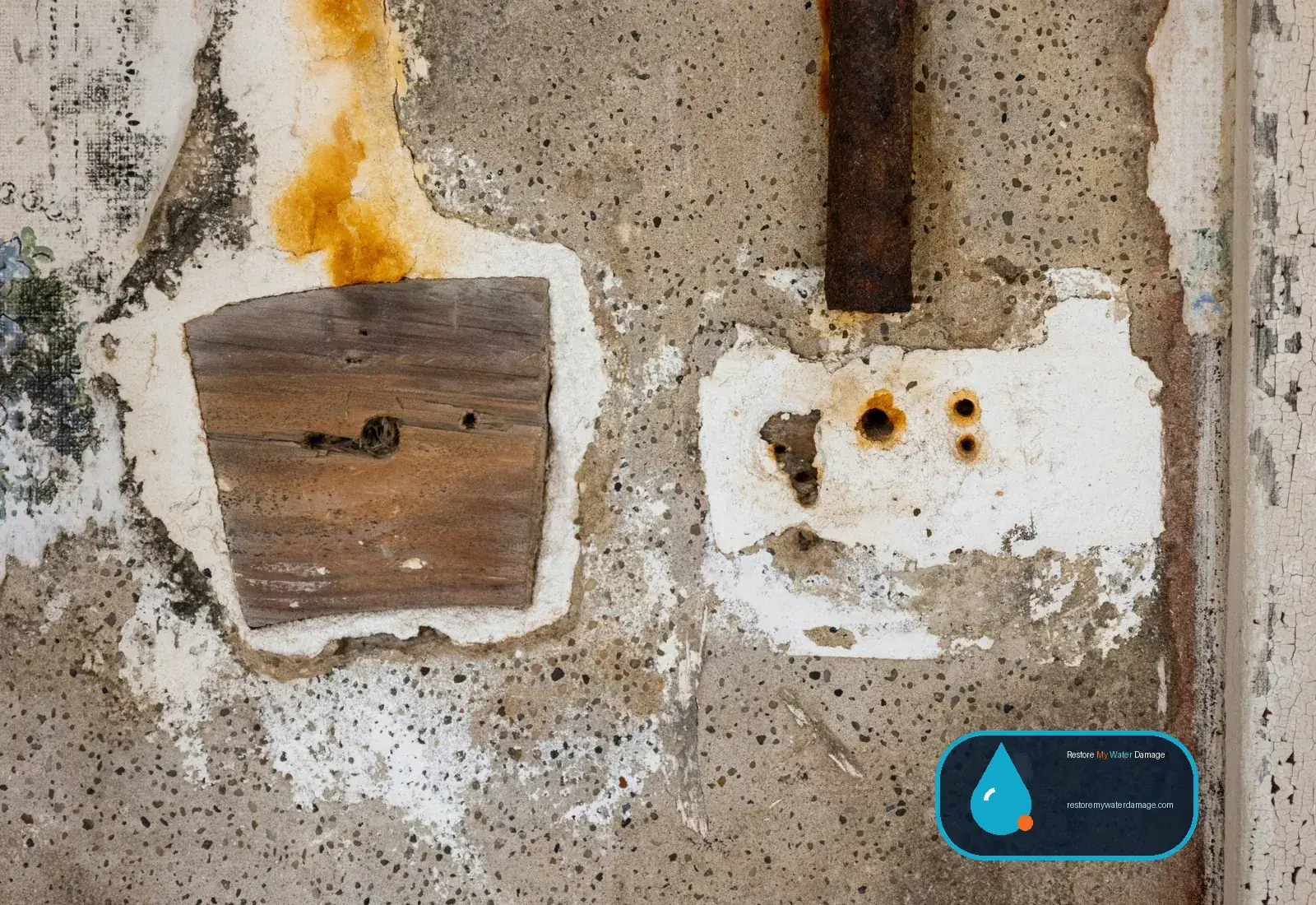
How does water damage lead to mold?
Mold spores are present nearly everywhere indoors and outdoors, waiting for moisture. When water damage soaks drywall, wood, carpet, insulation or cardboard, those materials provide both moisture and food. Given moderate temperatures and little airflow, spores can begin growing within roughly 24 to 48 hours. Mold is therefore not a separate problem from water damage but one of its most common consequences.
Mold needs four things: spores, a food source, suitable temperature and moisture. Homes and commercial buildings always have the first three. Spores float in on air and clothing, organic building materials provide food, and indoor temperatures suit many species. Moisture is the one factor you can realistically control. That is why the EPA and the restoration industry both say the key to mold control is moisture control.
In practice, mold after a water loss shows up in predictable places: the back side of wet drywall, under carpet pad, inside wall cavities along bottom plates, on subfloors beneath vinyl, in damp insulation, and in any area where drying was incomplete or delayed. Surfaces can look dry while the material behind them is still wet enough to support growth.
Key takeaway: The best mold remediation is prevention. Getting water out and verifying that materials are dry within the first day or two stops most mold before it starts.
What is the 24-48 hour mold growth window?
The 24-48 hour window is the general guidance, reflected by the EPA, that wet building materials and furnishings should be dried within about 24 to 48 hours to prevent mold growth. It is a practical rule of thumb, not an exact countdown. Growth can begin sooner in warm, humid, dirty conditions, and it can take longer in cool, dry ones. Either way, speed is the biggest factor you control.

What happens over time after a water loss
| Time since water event | What typically happens | Priority actions |
|---|---|---|
| First few hours | Water spreads and wicks into drywall, carpet and wood; contents start to absorb water | Stop the source, ensure electrical safety, extract water, move contents |
| Hours 24 to 48 | Drywall swells, odors develop, microbial growth may begin on organic materials | Professional drying in place, remove soaked pad and unsalvageable materials |
| Days 2 to 7 | Mold growth can become visible, musty odor increases, wood swells and warps | Assess for growth; remove affected porous materials; continue controlled drying |
| More than a week | Established growth, possible structural deterioration, greater health risk | Professional mold remediation under containment, then drying and rebuild |
Water category matters too. Clean Category 1 water gives you the most time; sewage and floodwater already carry microorganisms and organic nutrients, so microbial growth can progress faster. See water damage categories explained for more.
How do you prevent mold after water damage?
Prevent mold by stopping the water, extracting standing water immediately, removing materials that cannot be dried, and lowering humidity with dehumidifiers while air movers speed evaporation. Measure moisture in drywall, wood and subfloors rather than judging by touch. Keep drying until readings match unaffected materials. Only then should walls be closed or flooring reinstalled. Fast, verified drying is the most reliable form of mold prevention.
Mold prevention checklist after a leak
- Stop the water source and make the area electrically safe.
- Extract standing water with a wet vacuum or professional extractor as soon as possible.
- Pull up wet area rugs and move furniture; place foil or blocks under furniture legs.
- Remove soaked carpet pad, which rarely dries well in place.
- Remove baseboards and check the wall cavity for wet insulation.
- Run dehumidifiers continuously with doors and windows closed, unless outdoor air is clearly drier.
- Use air movers or fans aimed at wet surfaces, not just around the room.
- Measure moisture with a meter daily and keep drying until readings reach normal levels.
- Discard wet cardboard, paper and other items that cannot be dried quickly.
- Watch for musty odors, staining or bubbling paint over the following weeks.
Professional drying follows the IICRC S500 standard, using psychrometric readings such as grains per pound to confirm moisture is actually being removed. Learn how in water extraction and structural drying, or call (833) 435-4276 — we answer 24 hours a day, 7 days a week.
What are the signs of mold after water damage?
Common signs include a musty, earthy odor; black, green, white or gray spots or fuzzy patches; staining or discoloration that grows over time; peeling, bubbling or cracking paint; warped or soft drywall; and allergy-like symptoms that improve when you leave the building. Odor is often the first clue, especially when mold is hidden inside walls, under floors or in HVAC components.
Where to look for hidden mold
- Behind baseboards and at the bottom of drywall in rooms that got wet
- Under carpet pad and on the tack strip
- Under sinks and behind dishwashers, refrigerators and washing machines
- On the underside of subfloors from basements or crawlspaces
- Inside wall cavities with wet insulation
- Around windows with condensation or past leaks
- In attics, especially on roof sheathing near leaks or poor ventilation
- In HVAC drain pans, air handlers and duct liners
Opening walls to look for hidden mold can release spores. If you strongly suspect hidden growth in a large area, consider having a professional perform the inspection with appropriate precautions.
How can mold affect health?
Mold exposure can trigger allergic reactions such as sneezing, runny nose, red eyes and skin rash, and it can provoke asthma attacks in sensitive people. Mold can also irritate eyes, skin, nose, throat and lungs. People with allergies, asthma, weakened immune systems or chronic lung disease face greater risks. The EPA advises removing indoor mold growth regardless of species. Anyone with health symptoms should consult a healthcare provider.
Safety warning: People with asthma, allergies, compromised immune systems or respiratory disease, as well as infants and older adults, should stay out of areas with active mold or remediation work. Do not disturb large areas of mold without containment and respiratory protection. Never mix bleach with ammonia or other household cleaners.
When can you clean mold yourself and when do you need a professional?
EPA guidance indicates that small areas, generally less than about 10 square feet or roughly a 3-foot by 3-foot patch, can often be cleaned by the occupant with proper precautions, provided the moisture problem is fixed. Call a professional for larger areas, mold in HVAC systems, mold caused by sewage or contaminated water, hidden growth inside walls, or when occupants have health concerns.
| Situation | DIY may be reasonable | Professional recommended |
|---|---|---|
| Size of growth | Under about 10 square feet | Larger than about 10 square feet |
| Surface type | Hard, non-porous surfaces like tile, glass, sealed countertops | Drywall, insulation, carpet, ceiling tiles, structural wood with significant growth |
| Water source | Clean water that has been fixed | Sewage, floodwater or unknown contaminated water |
| Location | Accessible bathroom or window area | Inside walls, attics, crawlspaces, HVAC ducts |
| Occupant health | Healthy adults with no respiratory issues | Asthma, allergies, immune suppression, infants or elderly in the home |
| Recurrence | First occurrence | Mold keeps returning, indicating an unresolved moisture problem |
Safe DIY cleaning for small areas
- Fix the leak or moisture source first.
- Wear an N95 respirator, gloves and goggles without vent holes.
- Keep children, pets and sensitive people away.
- Lightly mist the surface to reduce airborne spores.
- Scrub hard surfaces with detergent and water, then dry completely.
- Bag and discard moldy porous items such as ceiling tiles, carpet pieces or cardboard.
- Do not paint or caulk over mold; paint applied over growth tends to peel and the mold continues.
- Monitor the area for returning odor or growth.
How does professional mold remediation work under IICRC S520?
Professional mold remediation under the IICRC S520 standard focuses on correcting the moisture source and physically removing mold contamination while preventing its spread. The typical process includes inspection, a written remediation plan, containment with plastic barriers and negative air pressure, HEPA air filtration, removal of contaminated porous materials, HEPA vacuuming and damp wiping of surfaces, drying, and post-remediation verification before rebuilding.

- Assessment. Identify visible growth, moisture sources and likely hidden contamination using moisture meters, thermal imaging and inspection. An independent indoor environmental professional may perform sampling in some cases.
- Remediation plan. Define the scope, containment level, materials to remove, worker protection and how the result will be verified.
- Moisture correction. Repair leaks, drainage, ventilation or humidity problems so mold does not return.
- Containment. Build polyethylene barriers around the work area, seal HVAC vents, and create negative air pressure with HEPA air filtration devices exhausted appropriately.
- Personal protection. Technicians wear respirators, protective suits, gloves and eye protection suitable for the contamination level.
- Removal. Cut out and bag moldy drywall, insulation, carpet and other porous materials. Double-bag debris before carrying it through clean areas.
- Surface cleaning. HEPA vacuum and damp wipe structural materials. Wood framing with surface growth may be sanded or cleaned; badly deteriorated wood is replaced.
- Drying. Confirm materials are dry before any sealing or rebuilding.
- Final cleaning. HEPA vacuum and wipe the entire contained area.
- Post-remediation verification. Confirm there is no visible mold or debris, no musty odor, and dry materials. Air or surface sampling may be used, ideally by an independent party.
- Reconstruction. Replace removed materials once verification is complete.
Why killing mold is not enough
Dead mold can still cause allergic and irritant reactions, which is why the S520 and EPA guidance both emphasize removal rather than simply spraying biocides. Encapsulating paints and sealers are not substitutes for removal, though they may be used on cleaned framing in some situations. Our standards page explains how IICRC references guide our approach.
How do water damage restoration and mold remediation work together?
When a water loss already has mold growth, the two processes are combined but carefully sequenced. Moldy areas are contained first so drying equipment does not blow spores through the building. Contaminated materials are removed under containment, then structural drying proceeds. Unaffected wet areas can be dried in parallel as long as air movement does not cross into contaminated zones. Verification checks both dryness and cleanliness.
Water damage restoration vs mold remediation
| Aspect | Water damage restoration | Mold remediation |
|---|---|---|
| Main goal | Remove water and dry materials to prevent further damage | Remove mold contamination and prevent spread |
| Primary standard | IICRC S500 | IICRC S520 |
| Airflow | Aggressive air movement across wet surfaces | Controlled airflow under negative pressure with HEPA filtration |
| Containment | Used for contaminated water or dust control | Central to the process |
| Material decisions | Dry in place when possible | Remove contaminated porous materials |
| Verification | Moisture readings reach dry standard | Visual, odor, moisture, sometimes sampling |
For the full water process, see our water damage restoration process guide.
Which materials can be saved when mold has grown?
Whether a moldy material can be saved depends mainly on porosity. Non-porous materials like metal, glass, hard plastic and sealed tile can usually be cleaned. Semi-porous materials such as solid wood framing can often be cleaned by HEPA vacuuming, wiping or sanding if the growth is on the surface and the wood is sound. Porous materials like drywall, ceiling tiles, insulation and carpet with mold growth generally need to be removed.
| Material | Typical approach when mold is present |
|---|---|
| Drywall and gypsum board | Remove and replace affected sections, typically with a margin beyond visible growth |
| Fiberglass or cellulose insulation | Remove and discard |
| Carpet and pad | Discard when moldy |
| Ceiling tiles | Discard |
| Wood studs, joists and sheathing | HEPA vacuum, clean, sand if needed and dry; replace if structurally compromised |
| Concrete and masonry | Scrub and clean; dry thoroughly |
| Hard furniture and non-porous items | Clean with detergent solution and dry |
| Upholstered furniture and mattresses | Usually discard if growth is present |
| Books, papers, photos | Discard or consult a document restoration specialist for valuable items |
| HVAC duct liner and flexible duct | Typically replaced if moldy |
How is mold handled in basements, attics, crawlspaces and HVAC?
Mold in hard-to-reach areas follows the same remediation principles, but each location has its own moisture source and access challenges. Basements usually suffer from groundwater and humidity, attics from roof leaks and poor ventilation, crawlspaces from ground moisture, and HVAC systems from condensation. Remediation in these areas must include correcting that specific moisture source, or growth will return after cleanup.
Basements
Basement mold typically grows on the back of finished drywall, on carpet pad over concrete, on stored cardboard and along bottom plates. Remediation often involves removing lower wall finishes, cleaning framing and concrete, then controlling humidity with a dehumidifier and addressing drainage. See basement water damage restoration for water entry causes.
Attics
Attic mold commonly appears on the underside of roof sheathing. Causes include roof leaks, bathroom or dryer vents exhausting into the attic, blocked soffit vents and air leaks carrying warm, moist air up from living spaces. Cleaning the sheathing is only part of the job; ventilation and air sealing must be fixed.
Crawlspaces
Crawlspaces often have exposed soil that releases moisture, plus plumbing leaks and outside humid air. Remediation may be followed by installing a vapor barrier, improving drainage and, where appropriate for the climate and local code, crawlspace encapsulation with dehumidification.
HVAC systems
Mold in air handlers, drain pans, coils or ducts can distribute spores throughout a building. EPA guidance recommends not running an HVAC system known or suspected to be contaminated, as it can spread mold. Cleaning should be done by qualified HVAC professionals following industry cleaning standards, and porous duct liner or flexible duct with growth is usually replaced.
How do you choose a mold remediation professional?
Choose a company whose staff are trained in IICRC S520 mold remediation and S500 water damage restoration, that carries liability insurance (ideally including pollution or mold coverage), holds any license your state requires for mold work, and provides a written remediation plan describing containment, removal and verification. Be cautious about companies that recommend only spraying or fogging, and consider independent post-remediation verification for larger projects.
Questions to ask
- What caused the mold, and how will the moisture source be fixed?
- What containment will you use, and will negative air pressure and HEPA filtration be in place?
- Which materials will be removed, and how far beyond visible growth?
- What protective equipment will your team wear?
- How will you verify the work is complete, and do you recommend independent verification?
- Can you provide proof of insurance and any required state licensing?
- Is the estimate itemized, and what happens if hidden mold is found?
Some states have specific licensing requirements for mold assessors and remediators, and some restrict the same company from both testing and remediating a project. Check your state's rules. Our guide to choosing a restoration company offers more vetting tips.
Do you need mold testing?
Often you do not. If mold is visible, EPA guidance says sampling is usually unnecessary because the response is the same: remove the mold and fix the moisture. Testing can help when mold is suspected but hidden, when health concerns need investigation, in real estate or legal disputes, or to verify that remediation worked. For impartial results, many people choose an independent assessor who is not performing the remediation.
- Air sampling: Compares indoor spore levels to outdoor samples; results vary with conditions and require interpretation.
- Surface sampling: Tape lifts or swabs identify whether a stain is mold growth.
- Moisture mapping: Often more useful than sampling for finding hidden problem areas.
There are no federal limits for indoor mold spore counts in homes. Results must be interpreted by a qualified professional in context.
What are common myths about mold after water damage?
Many mold myths lead people to underestimate the problem or waste money on the wrong fix. The most common are that bleach solves mold, that painting over it works, that only black mold matters, that a dry-looking surface is safe, and that testing is always necessary. Each misunderstanding delays the two actions that actually work: removing the growth and eliminating the moisture that feeds it.
| Myth | Reality |
|---|---|
| Bleach kills mold, so the problem is solved | Bleach does not penetrate porous materials well and does not remove dead mold, which can still cause reactions. Physical removal and moisture control are what matter. |
| Painting over mold seals it in | Paint does not stop active growth on damp materials; mold continues underneath and paint peels. |
| Only "black mold" is harmful | Many species can cause allergic and irritant reactions. The EPA advises removing indoor mold regardless of color or type. |
| If it looks dry, it is dry | Surfaces dry first. Wall cavities, subfloors and framing can stay wet enough to grow mold. Moisture meters tell the truth. |
| You always need a mold test | If mold is visible, testing usually does not change the response. Testing helps with hidden mold, health concerns or verification. |
| Air purifiers fix mold problems | HEPA filtration reduces airborne spores but does nothing about growth on wet materials. |
| Mold only grows in old or dirty homes | Any building with moisture and organic materials, including new construction, can grow mold. |
What should renters and landlords know about mold after water damage?
Renters should report leaks and water damage to the landlord promptly and in writing, with photos, because quick drying prevents mold and documentation protects both sides. Landlords are generally responsible for repairing building leaks and maintaining habitable conditions, though specific obligations depend on state and local law and the lease. Tenants are usually responsible for their own belongings, which is where renters insurance may help.
- Renters: Report the problem immediately, keep copies of communication, avoid disturbing large mold areas, and check your renters policy for contents coverage.
- Landlords: Respond quickly, stop the water source, arrange professional drying, and communicate a plan and timeline to tenants.
- Both: Some states and cities have specific mold disclosure or remediation rules. Local housing or health departments can explain requirements.
What should you do after mold remediation is finished?
After remediation, confirm the moisture source is repaired, review the verification results, and keep the area dry. Ask for written documentation of what was removed, how the work was verified and final moisture readings. Rebuild only after verification. Over the following months, watch for returning odor, staining or condensation, and keep indoor humidity controlled so the conditions that allowed growth do not come back.
- Keep the remediation report with your home records; it is useful for future sales and insurance questions.
- Replace HVAC filters after work is complete.
- Recheck the repaired leak or drainage issue after the next heavy rain.
Does insurance cover mold from water damage?
Insurance treatment of mold varies widely. Some homeowners policies cover mold resulting from a covered sudden water event, often with a separate, lower sublimit. Mold from gradual leaks, long-term humidity, condensation or maintenance issues is commonly excluded, and some policies exclude mold entirely. Reporting water damage quickly and taking steps to prevent further damage helps protect your claim. Always read the mold or fungi section of your policy.

Documentation tips
- Photograph the water damage when it happens, before mold appears.
- Keep records showing when the leak was discovered and when drying started.
- Save plumber or roofer reports identifying the cause.
- Keep moisture logs and remediation reports, including verification results.
- Note any health-related expenses separately and discuss them with your insurer and healthcare provider.
Read water damage and homeowners insurance for detailed claim steps.
How much does mold and water damage restoration cost?
Costs depend on how far water spread, how long it sat, and whether mold has already grown. As general national industry estimates, water mitigation alone for a small area often runs a few thousand dollars, while remediation of small contained mold areas may cost several hundred to a few thousand dollars. Large projects involving attics, crawlspaces, HVAC systems or whole floors can exceed $10,000. Prices vary widely by region and scope.
| Scope | General national range (varies widely) |
|---|---|
| Small area mold cleanup (under about 10 sq ft), professional | Roughly $500 to $1,500 |
| Single room with drywall removal and containment | Roughly $1,500 to $5,000 |
| Crawlspace or attic remediation | Roughly $2,000 to $8,000 or more |
| Multiple rooms, HVAC involvement or whole-floor remediation | $10,000 and up |
Cost drivers include affected area, accessibility, containment complexity, material removal, HVAC cleaning, post-remediation verification and reconstruction. Acting quickly after water damage is usually far less expensive than remediating established mold. More detail is in the water damage restoration cost guide.
How do you keep mold from coming back?
Mold returns when moisture returns. Keep indoor relative humidity below about 60 percent, and ideally between 30 and 50 percent as EPA guidance suggests. Fix leaks promptly, vent bathrooms, kitchens and dryers outdoors, maintain gutters and grading, insulate cold surfaces to reduce condensation, and run dehumidifiers in basements and crawlspaces. Inspect areas that were previously damaged for odor or staining.
- Use exhaust fans during and after showers and cooking.
- Inspect under sinks, around toilets and behind appliances regularly.
- Install water leak sensors near water heaters, washers and dishwashers.
- Keep HVAC condensate lines and drain pans clean.
- Clean gutters and extend downspouts away from the foundation.
- Ventilate or encapsulate crawlspaces where appropriate.
- Use mold-resistant drywall and non-organic flooring in basements and bathrooms when rebuilding.
- Monitor humidity with an inexpensive hygrometer.
Our water damage prevention guide covers these habits in detail. If you have fresh water damage or suspect mold after a leak, call (833) 435-4276 — we answer 24 hours a day, 7 days a week, and review related help for basement water damage restoration or flood damage restoration.
Frequently Asked Questions
How soon does mold grow after water damage?
Under favorable conditions, mold can begin growing on damp organic materials such as drywall paper, wood, carpet backing and cardboard within about 24 to 48 hours. Visible growth often takes longer to appear. Warm temperatures, high humidity, darkness and poor airflow speed things up. Prompt extraction and drying, ideally within that window, is the most effective way to prevent mold.
Can I clean mold myself?
EPA guidance suggests homeowners can often handle small areas, generally under about 10 square feet, on hard surfaces if they are healthy, wear protective gear and fix the moisture problem. Larger areas, mold in HVAC systems, growth caused by sewage or contaminated water, or anyone with health concerns calls for a qualified professional. Moldy porous materials like drywall and carpet usually need removal.
Does bleach kill mold?
Bleach can remove surface staining on non-porous surfaces, but it is not recommended as a routine mold fix. It does not penetrate porous materials well, adds moisture, and gives off irritating fumes. EPA guidance emphasizes physically removing mold with detergent and water and discarding moldy porous materials. Never mix bleach with ammonia or other cleaners, which creates toxic gases.
What is IICRC S520?
The IICRC S520 is the Standard for Professional Mold Remediation. It describes principles and procedures for assessing mold contamination, protecting workers and occupants, setting up containment, removing contamination at its source, cleaning, drying and verifying results. A central principle is that mold should be physically removed, not simply killed or covered, and that the moisture source must be corrected.
Should I test for mold?
Testing is not always needed. If you can see or smell mold, EPA guidance notes the priority is removing it and fixing the moisture, not identifying the species. Testing can be useful when mold is suspected but hidden, when occupants have health concerns, in legal or real estate situations, or to verify cleanup. Consider an independent indoor environmental professional who does not also perform the remediation.
Does homeowners insurance cover mold?
Coverage varies. Some policies cover mold that results from a covered sudden water loss, such as a burst pipe, often with a lower sublimit. Mold from long-term leaks, humidity or poor maintenance is commonly excluded. Some policies exclude mold entirely. Report water losses quickly and act to prevent further damage, since delay can affect coverage. Read your policy's mold or fungi language carefully.
How much does mold remediation cost?
As a general national industry estimate, small remediation jobs often cost from several hundred to a few thousand dollars, while projects involving large areas, attics, crawlspaces, HVAC systems or significant tear-out can run from several thousand to well over $10,000. Price depends on area size, location, access, containment needs, materials removed and rebuilding. Get a written scope and ask how clearance will be verified.
Is mold after water damage dangerous?
Mold exposure can cause allergic reactions, asthma attacks, and irritation of the eyes, nose, throat and skin. People with asthma, allergies, weakened immune systems or chronic lung conditions are at higher risk, and infants and older adults may be more sensitive. Not every mold causes the same effects, but the EPA advises removing indoor mold growth regardless of type. Consult a doctor about health symptoms.
How do I know if water damage has caused hidden mold?
Signs of hidden mold after water damage include a persistent musty smell, peeling paint or wallpaper, warped baseboards, dark staining that returns after cleaning, and allergy-like symptoms that ease when you leave home. Moisture meters and thermal cameras can locate wet cavities where mold grows unseen. If a leak went unnoticed for more than 48 hours, a professional inspection is worth considering. Call (833) 435-4276 24/7 and we'll connect you with local help.