When a restoration crew arrives at a water loss, the truck is loaded with equipment that looks unfamiliar to most property owners: rumbling extractors, snail-shaped fans, heavy dehumidifiers with hoses, boxy filtration units, and handheld meters and cameras. Each tool solves a specific problem, and understanding what it does helps you follow the process, ask good questions, and recognize whether a job is being handled professionally.
This guide groups the equipment into five categories: extraction, air movement, dehumidification, air filtration, and moisture detection and specialty drying. For each tool, it covers what it does, when it is used, its limitations, and how it fits into the larger drying plan. The underlying principles come from industry guidance such as the ANSI/IICRC S500 standard.
| Equipment group | Main purpose | Key tools |
|---|---|---|
| Extraction | Remove liquid water | Truck-mount extractors, portable extractors, submersible pumps, weighted extraction tools, wands |
| Air movement | Speed evaporation from wet surfaces | Centrifugal air movers, axial air movers |
| Dehumidification | Remove water vapor from the air | LGR dehumidifiers, desiccant dehumidifiers |
| Air filtration | Capture airborne particles; create negative pressure | HEPA air scrubbers, negative air machines |
| Detection and specialty drying | Find moisture, verify drying, dry hard-to-reach materials | Pin and pinless moisture meters, thermo-hygrometers, thermal cameras, wall cavity systems, drying mats |
What equipment is used to extract water?
Water extraction equipment includes truck-mounted extractors for high-volume suction, portable extractors for upper floors and tight access, submersible pumps for deep standing water, weighted extraction tools that compress carpet and pad while vacuuming, and wands for carpet and hard floors. Extraction removes liquid water far faster than evaporation, so it is always the first major step on a significant loss.
Truck-mounted extractors
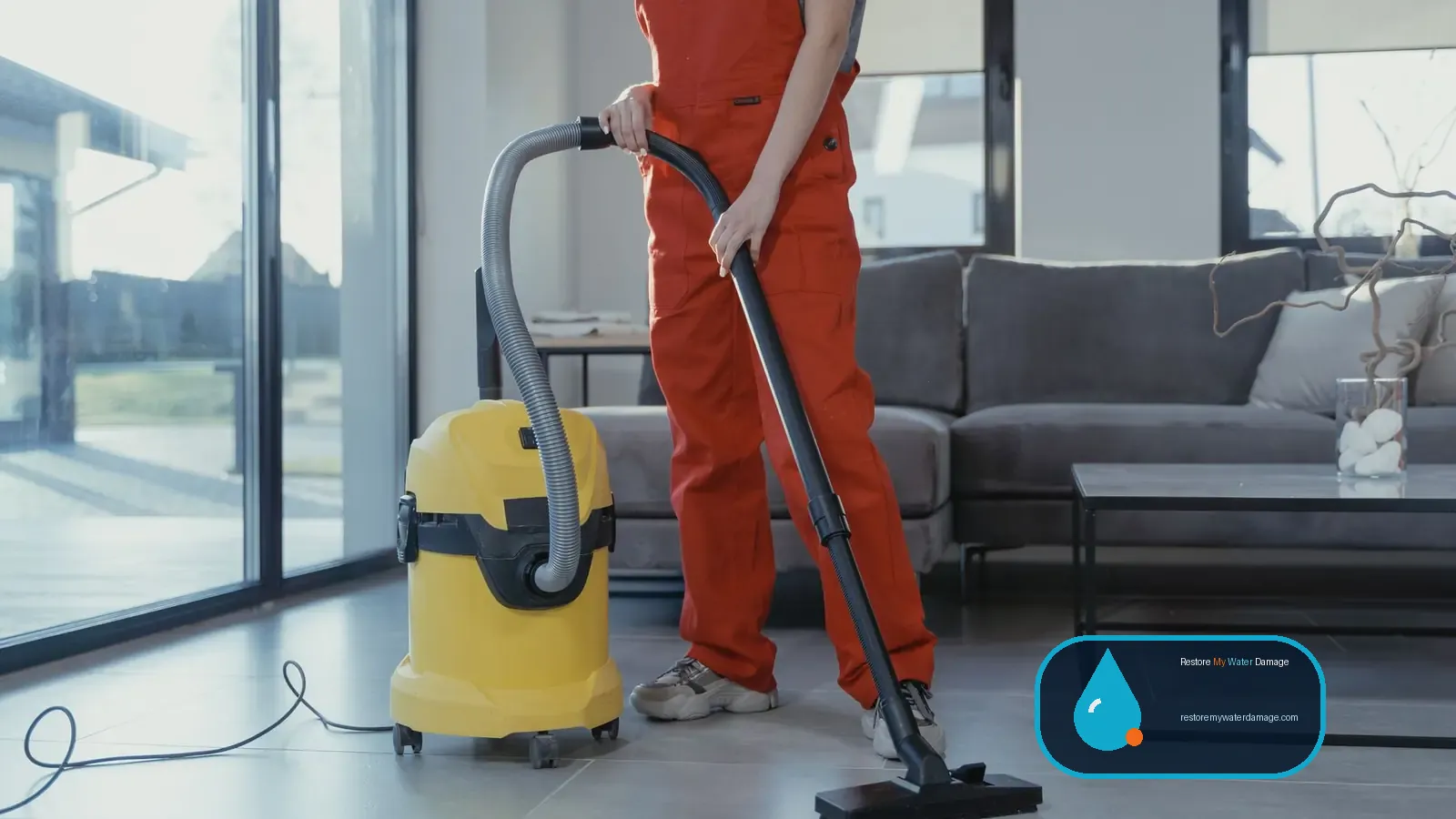
A truck-mount is a powerful vacuum and pump system built into a van or trailer, with long hoses run into the building. It delivers high suction and large recovery tank capacity, making it effective for large volumes of water across big areas and for heavy carpet extraction. Because the machine stays outside, it keeps exhaust and much of the noise out of the home.
Limitations: Hose length limits reach on high-rise or deep buildings, and vehicle access and parking are needed. Exhaust must be kept away from building openings.
Portable extractors
Portable extractors are wheeled units that plug into building power. They are used where a truck-mount cannot reach, such as upper floors of apartment buildings, and for smaller losses. Many models include a pump-out feature to discharge recovered water into a drain.
Limitations: Lower suction and smaller tanks than truck-mounts, and they rely on available electrical circuits.
Submersible pumps
For deep standing water in basements, crawlspaces, or elevator pits, submersible pumps move large volumes quickly before extractors take over. Trash pumps can handle water containing some solids.
Limitations: Pumps cannot remove the last inch or so of water, and electrical safety must be confirmed before anyone enters flooded areas. In basements with significant outside water pressure against walls, pumping too fast may be discouraged; a professional evaluates structural conditions.
Weighted extraction tools
Weighted or stand-on extraction tools are platforms a technician stands or rides on while they connect to an extractor. The body weight compresses carpet and pad, forcing water out while suction pulls it away. They typically remove substantially more water from carpet and pad than a standard wand, which reduces drying time and improves the chance of saving carpet on clean water losses.
Limitations: Mostly used on carpeted areas; less useful on hard surfaces. Pad is still often removed.
Wands and hard floor tools
Carpet wands, squeegee wands, and hard floor extraction heads remove water from surfaces. Hard floor tools reach grout lines and seams on tile and vinyl. Upholstery tools handle furniture where appropriate.
| Extraction tool | Best use | Main limitation |
|---|---|---|
| Truck-mounted extractor | Large volumes, big areas, heavy carpet extraction | Hose length and vehicle access |
| Portable extractor | Upper floors, smaller losses, limited access | Lower suction and tank capacity |
| Submersible pump | Deep standing water | Leaves residual water; electrical safety |
| Weighted extraction tool | Saturated carpet and pad | Carpeted areas only |
| Squeegee and hard floor wands | Tile, vinyl, concrete | Cannot reach water under flooring |
For why extraction comes first, see water extraction vs. drying.
What do air movers do, and what is the difference between centrifugal and axial?
Air movers blow high-velocity air across wet surfaces to speed evaporation by disrupting the saturated layer of air that forms against damp materials. Centrifugal air movers, the snail-shaped units, produce concentrated, higher-pressure airflow aimed at floors, wall bases, and cavities. Axial air movers produce higher volumes of lower-pressure air over wide areas. Many drying setups use both, depending on the space.
Centrifugal air movers
Centrifugal units pull air in and throw it outward through a narrow outlet. The result is focused, high-velocity airflow with enough pressure to push air under carpet (called floating carpet), into toe kick openings, and along wall bases. They can typically be set at different angles and stacked. They are the most common air mover on residential jobs.
Axial air movers
Axial units use propeller-style blades, like a powerful fan, moving a large volume of air in a wide pattern. They are efficient for large open areas, drying ceilings and walls over broad surfaces, and general air circulation. They often draw less power per unit of air moved but produce less focused pressure.
| Centrifugal air mover | Axial air mover | |
|---|---|---|
| Shape | Snail-shell housing with narrow outlet | Round or square housing with propeller blades |
| Airflow | Focused, higher velocity and static pressure | High volume, broad, lower pressure |
| Best for | Floors, wall bases, under carpet, cavities, toe kicks | Large open areas, walls and ceilings, circulation |
| Placement | Close to wet surfaces, often angled along walls | Positioned to sweep air across wide areas |
| Typical use | Most residential rooms | Commercial spaces, gyms, warehouses, big rooms |
How air movers are placed
Air movers are commonly placed along wet walls, pointed at the wall base, and angled so airflow travels in one direction around the room. Placement guidance generally scales with the square footage of wet floor and linear footage of wet walls, adjusted for class of loss. Air movers without matching dehumidification raise humidity, so they are always planned together with dehumidifiers.
Air movers should not be used to dry areas affected by Category 3 water or visible mold before contaminated materials are removed and containment is in place, because high-velocity air can spread contaminants. Technicians follow containment procedures in those situations.
How do LGR and desiccant dehumidifiers differ?
Low grain refrigerant (LGR) dehumidifiers cool air below its dew point so moisture condenses on coils, then reheat and release drier air; they are designed to keep removing moisture at lower humidity than standard units. Desiccant dehumidifiers pass air through a moisture-absorbing wheel, then use heat to release and exhaust that moisture outdoors. Desiccants work better in cold spaces and can reach very low humidity.
Low grain refrigerant (LGR) dehumidifiers
LGR units work like an advanced air conditioner. Humid air passes over a cold coil, water condenses and drains into a pump or hose, and the air is rewarmed as it exits. Standard refrigerant dehumidifiers lose effectiveness as air gets drier because the coil can only pull out moisture when air is above the coil's dew point. LGR designs use pre-cooling and other refinements to keep pulling moisture at lower grain levels, which is what restoration drying demands.
Strengths: Efficient in typical indoor temperatures, widely used, relatively simple setup, water discharged through a hose.
Limitations: Performance drops in cold spaces, such as unheated basements and winter crawlspaces, because coil frost and low temperatures reduce condensation.
Desiccant dehumidifiers
Desiccant units use a slowly rotating wheel coated with a material, such as silica gel, that absorbs moisture. Process air passes through one section of the wheel and exits dry. A separate reactivation airstream is heated and passed through another section, driving moisture out of the wheel and exhausting it outside through ducting.
Strengths: Effective at low temperatures, capable of very low humidity, helpful for Class 4 materials such as hardwood, plaster, and concrete, and for large commercial spaces.
Limitations: Require exhaust ducting to the outdoors, higher energy use from heaters, and the exhausted wet air must be directed away from building intakes.
| LGR dehumidifier | Desiccant dehumidifier | |
|---|---|---|
| How it removes moisture | Condensation on cold coils | Adsorption into desiccant, released by heat |
| Best temperature range | Normal indoor temperatures | Cold to moderate temperatures |
| Lowest achievable humidity | Low | Very low |
| Water disposal | Drain hose or internal pump | Vapor exhausted outdoors through duct |
| Typical use | Most residential and light commercial losses | Hardwood, concrete, plaster, cold spaces, large buildings |
| Setup complexity | Lower | Higher, requires ducting |
How dehumidifier performance is checked
Technicians measure the grains per pound (GPP) of air entering and leaving the dehumidifier. A meaningful drop between inlet and outlet shows the unit is removing moisture. They also compare the affected area to unaffected indoor air and outdoor air. If GPP in the affected area is not dropping over time, equipment is adjusted or added.
What is an air scrubber, and when is HEPA filtration used?
An air scrubber, also called an air filtration device, pulls air through a series of filters, typically ending with a HEPA filter, to capture airborne particles such as dust, mold spores, and debris from demolition. It is commonly used during removal of damaged materials, on Category 3 losses, and where mold is present. Ducted to the outside of a containment, it creates negative air pressure to help keep contaminants from spreading.
How air scrubbers work
Most units use a pre-filter to catch larger debris, an intermediate filter, and a HEPA filter. True HEPA filters are rated to capture at least 99.97 percent of particles at 0.3 microns, the most penetrating particle size. Some units include activated carbon filters to reduce odors.
Recirculating versus negative air
- Recirculating (scrubbing) mode: The unit filters air within a room and releases it back into the same space, reducing airborne particulate.
- Negative air mode: The unit is placed inside a sealed containment and its exhaust is ducted outside the containment, often outdoors. Pulling air out creates lower pressure inside the work area, so air flows in through small gaps rather than out, helping keep contaminants contained.
When air filtration is typically used
- Category 3 water losses such as sewage backups and floodwater
- Visible mold or suspected mold behind surfaces
- Demolition of drywall, plaster, insulation, and flooring
- Homes with occupants who have respiratory concerns
- Fire and water losses with soot and particulate
Limitations: Air scrubbers do not remove moisture, do not replace physical cleaning or removal of contaminated materials, and filters must be changed and handled properly. For mold-related work, see mold and water damage and fire and water damage restoration.
What tools are used to find and measure moisture?
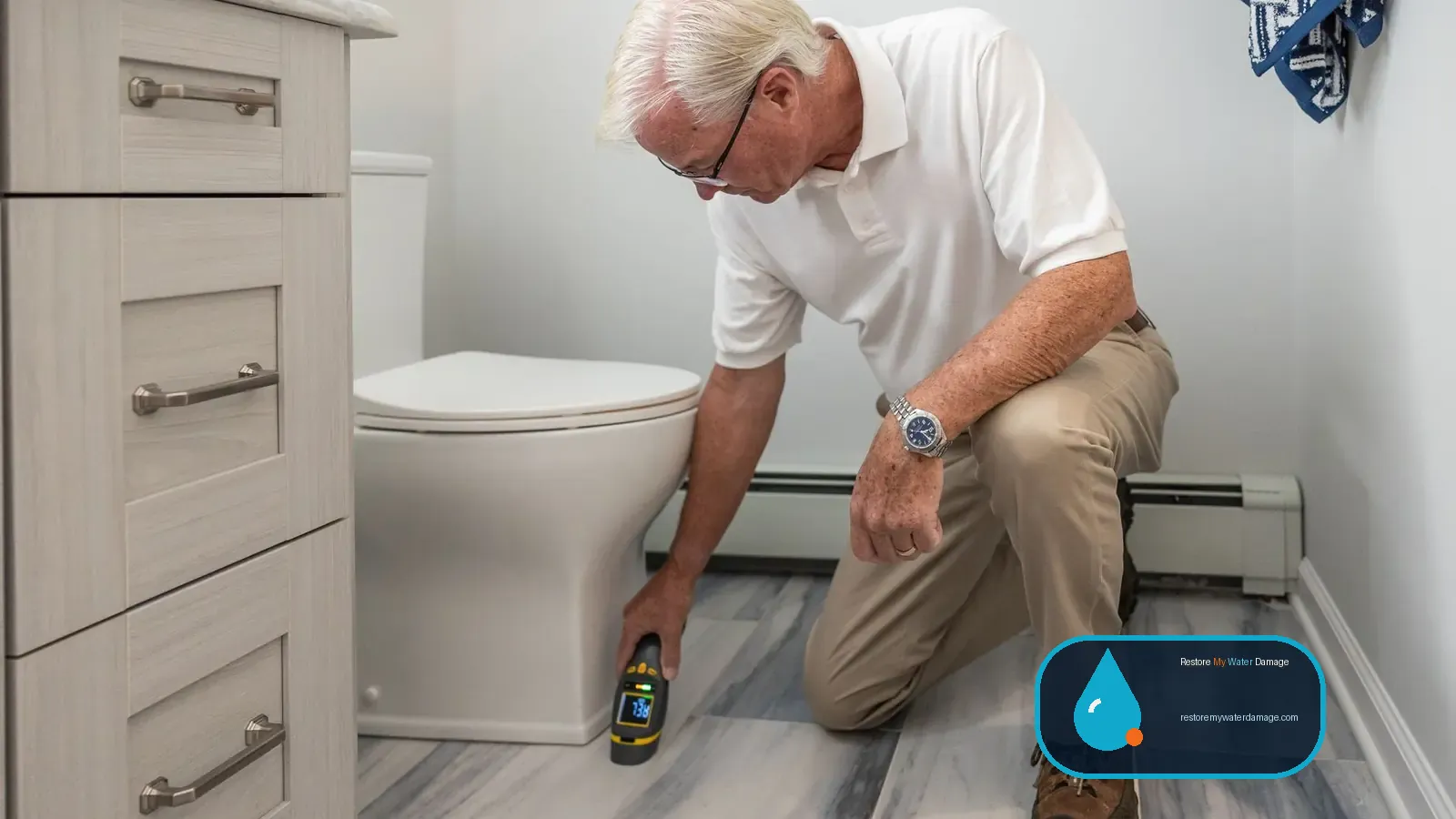
Moisture detection relies on pin moisture meters that measure resistance between probes inserted into materials, pinless meters that scan beneath surfaces without damage, thermo-hygrometers that measure air temperature and humidity, and thermal imaging cameras that reveal temperature patterns suggesting hidden moisture. Together they map the wet area, set drying goals, track progress daily, and confirm when drying is complete.
Pin (penetrating) moisture meters
Pin meters push two metal pins into a material and measure electrical resistance between them. Wet materials conduct better and read higher. Many pin meters are calibrated for wood and show moisture content as a percentage for wood; on drywall and other materials, readings are often relative or use reference scales. Insulated pins can take readings at a specific depth, such as through the face of hardwood into the lower part of a board.
Strengths: Precise location, depth readings with insulated pins, useful for wood species settings.
Limitations: Leaves small holes, readings on non-wood materials are relative, and salts or contaminants can raise readings.
Pinless (non-penetrating) moisture meters
Pinless meters use an electromagnetic field to sense moisture below the surface to a limited depth, without puncturing it. They are ideal for quickly scanning large areas of walls, floors, and cabinets to map where moisture is.
Strengths: Fast, non-destructive, good for mapping and finished surfaces.
Limitations: Readings are affected by density, metal fasteners, pipes, and wiring behind surfaces; depth is limited; results are relative.
Thermo-hygrometers
A thermo-hygrometer measures air temperature and relative humidity. Most professional models calculate dew point and grains per pound. These atmospheric readings show whether the drying environment is working: whether dehumidifiers are pulling moisture, whether the affected area is drier than outside, and whether conditions favor evaporation.
Thermal imaging cameras
Thermal cameras display surface temperature differences as color images. Because evaporation cools surfaces, wet drywall, ceilings, and floors often appear cooler than surrounding dry areas. A thermal camera can reveal the outline of a leak path behind a wall or ceiling that is invisible to the eye.
Limitations: Thermal cameras do not detect moisture directly. Missing insulation, air leaks, HVAC ducts, and sunlight can produce similar patterns. Every suspect area should be confirmed with a moisture meter.
| Tool | What it measures | Best used for | Main limitation |
|---|---|---|---|
| Pin moisture meter | Electrical resistance in material | Precise readings, wood, depth checks | Leaves holes; relative on many materials |
| Pinless moisture meter | Electromagnetic response below surface | Fast mapping of walls and floors | Affected by density and metal |
| Thermo-hygrometer | Air temperature and relative humidity | Tracking GPP and drying conditions | Measures air, not materials |
| Thermal imaging camera | Surface temperature | Locating suspect wet areas behind surfaces | Does not measure moisture; must confirm |
Using detection tools to verify drying
- Scan with a thermal camera and pinless meter to find suspect areas.
- Confirm with pin or pinless readings and draw a moisture map.
- Take dry standard readings on similar unaffected materials.
- Set drying goals for each material.
- Record atmospheric readings in affected, unaffected, outdoor, and dehumidifier exhaust air.
- Repeat material and atmospheric readings daily at marked points.
- Confirm all materials reach drying goals before removing equipment.
What specialty drying equipment is used for walls, floors, and cabinets?
Specialty drying systems reach water that surface air cannot. Wall cavity drying systems, often generically called injection or inject-drying systems, push dry air through small holes into wall and ceiling cavities and under cabinets. Hardwood floor drying mats and panels seal against floors and use suction or pressure to pull moisture up through boards. These methods can save materials that might otherwise be removed.
Wall cavity and cabinet drying systems
These systems use a blower connected to a manifold with multiple small hoses and injection needles or nozzles. Technicians drill small holes near the base of the wall, often behind removed baseboards where they will be hidden, or into cabinet toe kicks, and direct warm, dry air into the cavity. The airflow moves through the cavity, carrying moisture out. Some systems can also run in reverse to pull air.
- Common uses: Drywall cavities with clean water, under cabinets, behind tub surrounds, ceiling cavities, stairwell voids.
- Advantages: Less demolition, faster drying of hidden areas, often lower reconstruction cost.
- Limitations: Not appropriate when cavities contain saturated insulation that cannot dry, contaminated water, or visible mold. Fire blocking and wall construction affect airflow.
Hardwood floor drying mats and panels
Floor drying systems place mats or panels on the floor surface, seal the edges, and connect them to a vacuum or pressure source. Vacuum draws moisture up through the boards and seams, while a desiccant or LGR dehumidifier keeps the air dry. Some systems also dry subfloors from below in basements or crawlspaces.
- Common uses: Solid and some engineered hardwood, subfloors, wood stairs.
- Advantages: Can allow cupped boards to flatten as moisture balances; may avoid floor replacement.
- Limitations: Slow; severe buckling or contaminated water may still require replacement; results vary by species and installation.
Heat and other specialty methods
Some losses use controlled heat, such as indirect-fired heaters or electric heat drying systems, to raise material temperatures and speed evaporation, combined with dehumidification or ventilation. Heat must be managed carefully to avoid damaging wood, finishes, and sensitive contents. Concrete slabs and masonry may need extended drying with desiccants.
| Specialty system | Targets | Typical category limits |
|---|---|---|
| Wall cavity drying system | Wall and ceiling cavities, under cabinets | Generally clean water; not for contaminated cavities |
| Hardwood floor drying mats | Hardwood and subfloors | Primarily clean water losses |
| Floating carpet with air movers | Carpet and pad from beneath | Clean water with intact carpet |
| Controlled heat drying | Dense materials and large spaces | Depends on materials and contamination |
| Desiccant with ducted delivery | Crawlspaces, cold areas, concrete | Varies |
How is equipment matched to the class of water damage?
Equipment is matched to the evaporation load, which the IICRC S500 describes through classes of water loss. Class 1 needs relatively little equipment. Class 2 needs more air movement and dehumidification. Class 3, with saturated walls, ceilings, and floors, needs the most capacity. Class 4, involving dense materials, often needs desiccants, drying mats, or cavity systems. Quantities are calculated, then adjusted from daily readings.
| Class | Typical situation | Common equipment emphasis |
|---|---|---|
| Class 1 | Small wet area, low-porosity materials | Limited air movers, one dehumidifier, meters |
| Class 2 | Whole room, wet carpet, wicking below about 24 inches | Extraction, air movers along walls, LGR dehumidification |
| Class 3 | Water from above, saturated ceilings, walls, insulation, floors | High dehumidification capacity, many air movers, possible removal of ceiling materials |
| Class 4 | Hardwood, plaster, concrete, crawlspaces | Desiccants, floor drying mats, cavity systems, extended monitoring |
See water damage categories explained for more on classes and categories.
What should property owners know about living with drying equipment?
Drying equipment usually runs continuously, draws significant power, produces noise and warm air, and uses cords that can be trip hazards. Leave units running and in place, keep children and pets away, do not cover or block equipment, and keep cords dry. Tell your technician about tripped breakers, unusual smells, or anyone in the home with health concerns. Ask how many days equipment is expected to stay.
- Power: Several air movers and dehumidifiers can trip breakers. Technicians distribute load across circuits and may bring power distribution equipment.
- Noise: Expect steady fan noise. Closing doors may be part of the drying plan; ask before changing anything.
- Heat: Dehumidifiers release warm air; rooms may feel warmer.
- Trip hazards: Watch cords and hoses, especially at night.
- Pets and children: Keep fingers and paws away from intakes and outlets.
- Do not turn equipment off: Interrupting drying can extend the job.
- Electricity costs: Drying adds to your utility bill. Keep bills in case your insurer reimburses them; check your policy and ask your adjuster.
How does professional equipment compare with rental or household tools?
Household wet/dry vacuums, box fans, and home dehumidifiers can help with small, clean water spills caught immediately. Professional equipment offers much higher extraction suction, weighted extraction, higher-capacity LGR and desiccant dehumidification, HEPA filtration, specialty cavity and floor drying, and, most importantly, the meters and training to find hidden moisture and verify drying. Tools alone do not determine outcomes; measurement and adjustment do.
| Need | Household or rental option | Professional option |
|---|---|---|
| Standing water removal | Wet/dry shop vacuum | Truck-mount or portable extractor, submersible pump |
| Carpet and pad water | Rental carpet cleaner | Weighted extraction tool |
| Air movement | Box or pedestal fans | Centrifugal and axial air movers |
| Dehumidification | Household dehumidifier | LGR and desiccant dehumidifiers |
| Air quality | Portable room air purifier | HEPA air scrubbers, negative air containment |
| Hidden moisture | Touch and visual inspection | Pin and pinless meters, thermal imaging |
| Wall and floor cavities | Not typically available | Cavity drying systems, floor drying mats |
| Verification | Guesswork | Documented readings against dry standards |
For guidance on when to call a professional, see what to do after a water leak. To understand how equipment fits into the full job, read the water damage restoration process, and to evaluate providers, see how to choose a water damage restoration company. Service details are on our water extraction and structural drying page.
What should you ask your contractor about equipment?
Ask what equipment is being placed and why, how quantities were determined, how moisture will be measured and how often, what the drying goals are, whether specialty systems could reduce demolition, when air filtration is needed, and how long equipment is expected to stay. A professional should explain the plan clearly and share readings. Vague answers or no measurements are reasons for concern.
- What class and category did you assign, and how did that shape the equipment plan?
- How many air movers and dehumidifiers are you placing, and how did you calculate that?
- Are you using LGR or desiccant dehumidifiers, and why?
- Will you use wall cavity or floor drying systems to avoid removing materials?
- Do you need air scrubbers or containment for this job?
- What are the drying goals, and where are the dry standard readings?
- How often will you take readings, and can I see the logs?
- Which circuits will the equipment use, and what should I do if a breaker trips?
- How many days do you expect equipment to be on site, and what would change that?
Frequently Asked Questions
What equipment is used for water damage restoration?
Typical equipment includes truck-mounted and portable extractors, submersible pumps, weighted extraction tools, air movers, low grain refrigerant and desiccant dehumidifiers, HEPA air scrubbers, moisture meters, thermo-hygrometers, thermal imaging cameras, wall cavity drying systems, and hardwood floor drying mats. The mix depends on the water category, the class of loss, the materials affected, and the building's conditions.
What is the difference between an LGR and a desiccant dehumidifier?
An LGR, or low grain refrigerant, dehumidifier cools air across coils so moisture condenses, and it is designed to keep working at lower humidity than standard units. A desiccant dehumidifier uses a moisture-absorbing material and heat to pull vapor from air and exhausts it outside. Desiccants perform better in cold conditions and can achieve very dry air, which helps with dense materials.
How many air movers and dehumidifiers do I need?
It depends on the size of the affected area, the number of wall and floor surfaces that are wet, the class of loss, and the equipment's capacity. Industry guidance such as the IICRC S500 provides calculation methods based on these factors. Technicians then adjust quantities and placement based on daily readings. More equipment is not automatically better if it is not balanced.
Can I rent professional water damage equipment myself?
Some equipment, such as wet/dry vacuums, carpet extractors, fans, and dehumidifiers, is available to rent. Rental units are often smaller than professional equipment, and the harder part is knowing where moisture is hiding and when materials are dry, which requires meters and experience. For small, clean water spills, rentals may help. For larger losses, professional assessment is usually worthwhile.
Are moisture meters accurate?
Moisture meters are useful but work best as comparison tools. Pin meters measure resistance and are often calibrated for wood, so readings in drywall or concrete are relative. Pinless meters scan beneath the surface but can be affected by metal and density. Technicians compare readings in affected materials to readings from similar dry materials in the same building to judge progress.
Does a thermal imaging camera detect water?
Not directly. A thermal camera shows surface temperature differences. Wet materials often appear cooler because evaporation draws heat away, so thermal imaging helps locate suspect areas behind walls and under floors. Other things also cause temperature differences, such as insulation gaps and drafts, so any suspect area should be confirmed with a moisture meter.
Why is drying equipment so loud and power hungry?
Air movers use powerful motors to push high-velocity air, and dehumidifiers run compressors or heaters and fans continuously. Several units on one job can draw considerable electricity and create steady noise. Equipment usually runs around the clock because stopping it slows drying. Ask your technician about expected power use and which circuits the equipment will use.
What is an air scrubber used for in water damage?
An air scrubber, or air filtration device, draws air through filters, typically including a HEPA filter, to capture airborne particles such as dust, mold spores, and debris released during demolition and drying. It can also be ducted to create negative air pressure in a contained work area, helping limit the spread of contaminants to clean parts of the building.
How much does it cost to rent water damage drying equipment?
Rental prices vary by store and region, but typical national ranges run roughly tens of dollars per day for an air mover and more for a commercial dehumidifier, so a multi-day setup can add up quickly. Restoration companies usually bill equipment per unit per day. Rentals rarely include moisture mapping, so drying may be incomplete without proper monitoring. Call (833) 435-4276 24/7 and we'll connect you with local help.
How long should drying equipment run after water damage?
Most clean water losses need air movers and dehumidifiers running around the clock for about three to five days, but the right answer comes from moisture readings, not the calendar. Equipment should stay until wood, drywall and subfloor readings reach normal dry levels for that material. Turning equipment off early can leave hidden moisture that leads to mold.